The Future of FinOps Tools Is Conversational and Directly Linked to Execution
TL;DR FinOps is moving from dashboards to intelligent workflows. CloudBalance connects directly to Claude through MCP, giving teams live AWS cost intelligence inside their AI workflow. But this is more than chat: Claude can analyze, prioritize, and propose actions, and CloudBalance connects those insights directly to execution.
- Live AWS cost + optimization data within Claude
- FinOps reasoning via CloudBalance skills
- Structured playbooks, not just questions
- Direct links from insight to execution workflows
- Foundation for a virtual FinOps engineer
The Shift Is Already Happening
Engineers are increasingly working within AI tools like Claude, ChatGPT, Copilot and Cursor.
FinOps has not fully caught up. Cost intelligence still tends to live in dashboards, requiring context switching, manual analysis, and delayed action. Automated solutions exist, but they are typically narrowly scoped to tasks like purchasing commitments.
That model is starting to break.
The new model is simple: FinOps analysis and execution should happen in AI tools where work is increasingly being done.
We built CloudBalance's Claude integration around that idea.
From Tools to a virtual FinOps engineer
Large language models have crossed a threshold both in raw intelligence and ease of use. They routinely use tools, reason through complex problems, create detailed plans, and dynamically apply domain knowledge. And the improvements are accelerating.
When you combine that capability with:
- Structured FinOps knowledge (skills)
- Repeatable analyses (playbooks)
- Live cost and usage data (MCP servers)
- Execution workflows (CloudBalance)
You get something new:
A system that starts to behave like a virtual FinOps engineer.
Not just answering questions, but identifying opportunities, applying FinOps reasoning, prioritizing actions, and guiding execution.
This is what we are building toward at CloudBalance.
How CloudBalance Enables This
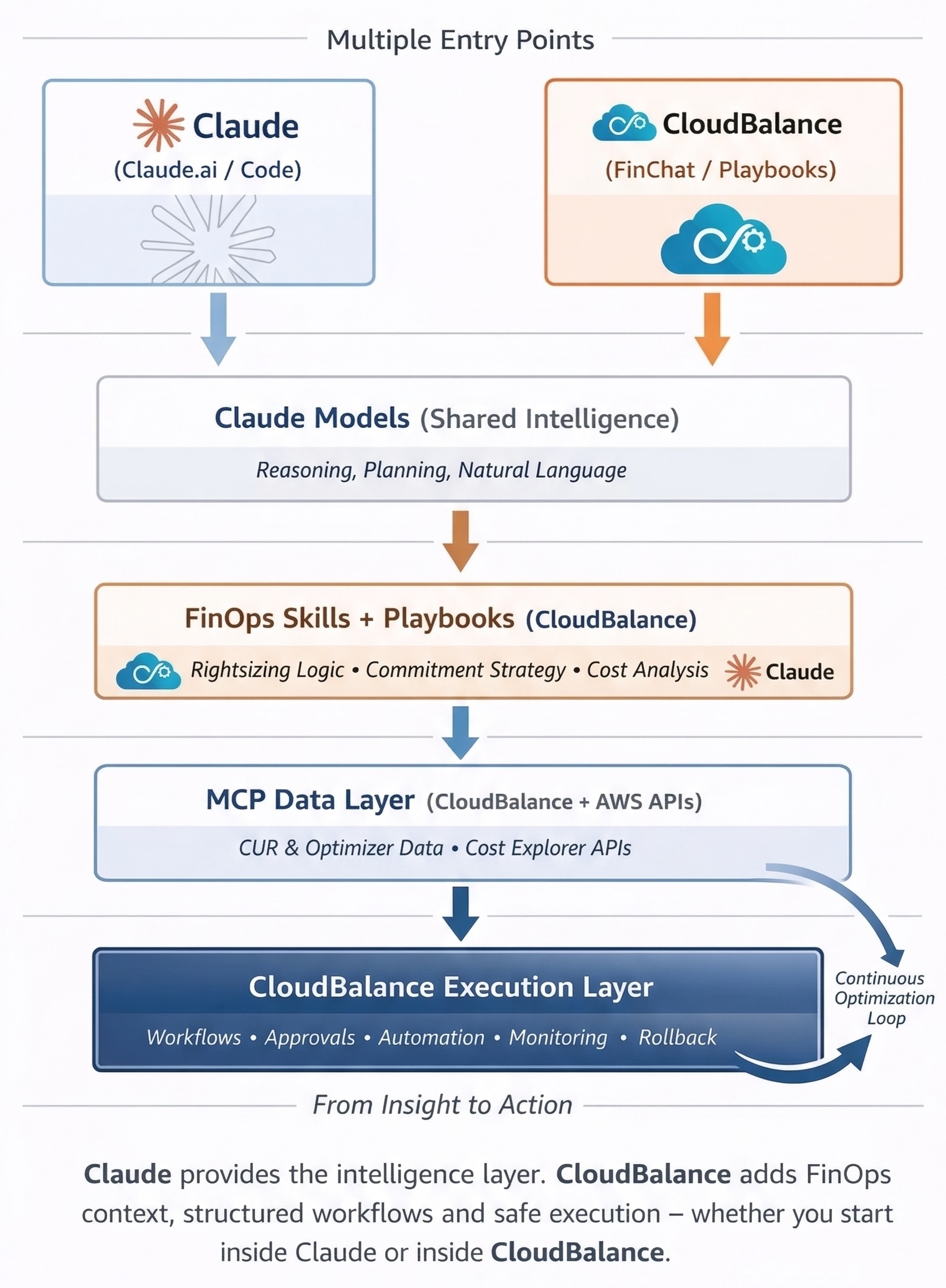
The system is built on four layers working together:
1. Data (MCP)
CloudBalance exposes live AWS cost, usage, and optimization data directly to Claude, including rightsizing recommendations, commitment performance, and cost trends.
2. Reasoning (Skills)
CloudBalance skills provide FinOps context: how to interpret utilization, when not to rightsize, how Savings Plans impact decisions, and how experienced FinOps practitioners think about tradeoffs.
3. Workflows (Playbooks)
Instead of one-off questions, Claude can run structured analyses like rightsizing proposals, cost investigations, and commitment reviews. All done consistently and repeatably.
4. Execution (CloudBalance)
Every insight can link directly into CloudBalance workflows for review, approval, scheduling, and execution with guardrails built in.
While many teams will access this through Claude, the underlying system is not tied to a single interface.
CloudBalance uses the latest Claude models internally to power FinChat and FinOps playbooks, bringing the same reasoning capabilities directly into the platform.
Whether you start in Claude or within CloudBalance, the experience is consistent: live data, structured FinOps reasoning, and direct paths to execution.
Claude is the intelligence layer. CloudBalance is the system that makes it operational.
How the Integration Works
Add the CloudBalance MCP servers and skills, authenticate in your browser, and Claude connects without requiring API keys in local config files.
You → Claude (claude.ai or Claude Code)
      → CloudBalance MCP server
          → CloudBalance cost and optimization data
          → Live AWS billing and cost APIs when needed
      ← Structured results
      ← Claude applies CloudBalance FinOps skills and playbooks
You ← A grounded answer with links back to CloudBalance
Authentication is OAuth 2.0 with PKCE. Open Claude, paste your MCP server URL, authorize through CloudBalance in your browser, and you are connected. No API key files, no .env setup.
What This Looks Like in Practice
Because CloudBalance combines live cost data, FinOps reasoning, and structured workflows, the conversation can move beyond reporting.
Understand cost changes
"What drove our AWS spend up last month?"
Claude can break down the change by service, account, or usage driver, quantify the deltas, and link directly to the relevant CloudBalance cost analysis.
Prioritize rightsizing work
"What are our highest-value EC2 and EBS optimization opportunities right now?"
Claude can rank opportunities by savings, explain the recommendation, flag caveats, and point your team to the workflow to review and schedule the change.
Evaluate commitment performance
"Are our Savings Plans and Reserved Instances performing the way we expected?"
Claude can pull coverage, utilization, savings, and expiration context, then surface whether the issue is underutilization, undercoverage, or an upcoming renewal decision.
Explore strategic changes
"Is it worth moving our m5 fleet to Graviton?"
Claude can combine current usage and cost context with CloudBalance methodology to estimate savings, highlight fit considerations, and direct you to the next step.
Run or schedule a structured FinOps playbook
"Run an EC2 rightsizing proposal for us."
Claude can fetch recommendations, rank them by savings and risk, and produce a prioritized proposal ready for your team to review and approve.
The point is not just asking FinOps questions in natural language. It is starting with a question, getting a grounded answer, and moving directly into a workflow to act on it.
Why This Is Different
Most "AI for FinOps" approaches stop at chat.
CloudBalance is building something else:
- Not just answers: grounded in live AWS and CloudBalance data
- Not just retrieval: guided by FinOps reasoning
- Not just prompts: structured playbooks
- Not just insights: connected to execution workflows
Built for Action — With Guardrails
Agent-driven FinOps only works if it is grounded in real data and wrapped in the right controls.
The goal is not to let an AI model make uninformed infrastructure changes. The goal is to shorten the path from insight to safe action.
That is why CloudBalance keeps execution workflows, approval steps, scheduling, auditability, and operational controls in the product itself. Claude helps your team find and understand the opportunity faster. CloudBalance keeps the path to execution structured, reviewable, and safe.
Where This Is Going
We are still early.
Today, Claude helps analyze and guide decisions. Tomorrow, these workflows become more composable:
- Custom FinOps playbooks defined by your team
- Multi-step workflows combining analysis and action
- Automated monitoring and re-evaluation loops
- Safe execution with rollback and guardrails
Claude Code and other leading platforms continue to advance rapidly. Subagents, agent teams, and new model capabilities are expanding what is possible at a pace we have not seen before. CloudBalance will continue to evolve alongside these advances to make agent-driven FinOps and a true virtual FinOps engineer a reality.
Even with the rapid advancement, the direction is clear:
From dashboards to conversations to autonomous FinOps workflows.
Try It
CloudBalance's Claude integration is available now for teams that want FinOps intelligence inside their AI workflow.
If you're already a CloudBalance customer: go to Integrations → Claude Setup to connect Claude and start asking questions against your live AWS cost and optimization data.
If you're new to CloudBalance: start a free trial, connect your AWS account, and see how quickly your team can go from "What is driving spend?" to "What should we do about it?"
Prefer to stay within CloudBalance? FinChat and native playbooks are powered by the same Claude models. No external tools required.